
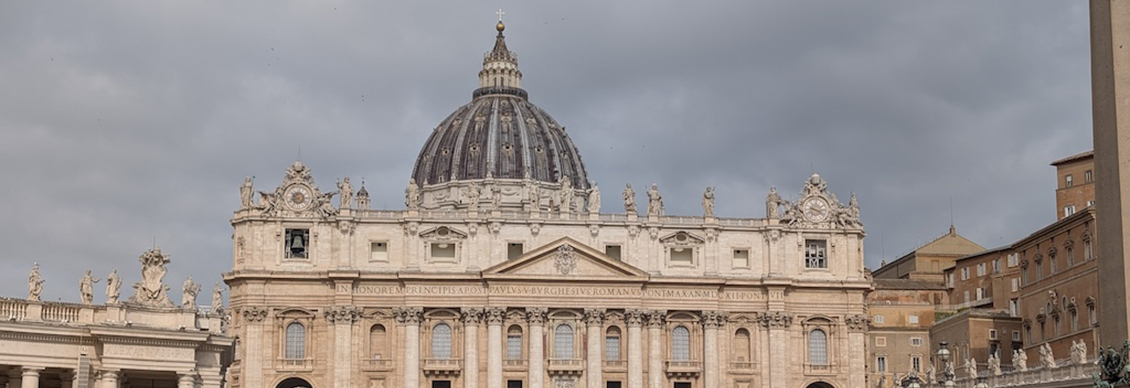
St. Peter’s Basilica is one of the most famous churches in the world and one of the central landmarks of Vatican City. It stands on a site that has been important to Christians for nearly two thousand years, because Catholic tradition holds that Saint Peter, one of Jesus’s apostles and the first bishop of Rome, was buried there after his martyrdom. For many visitors, the basilica is not only an architectural wonder but also a major place of pilgrimage and a symbol of the long history of the papacy.
It was a pretty early start to the day, and our tour guide was clearly an Olympic Speed-walker at some point in her life. She certainly made it difficult to keep up with her, and given the sea of humanity that we waded into, keeping a sharp eye on this diminutive informant of the historical was going to be a challenge.
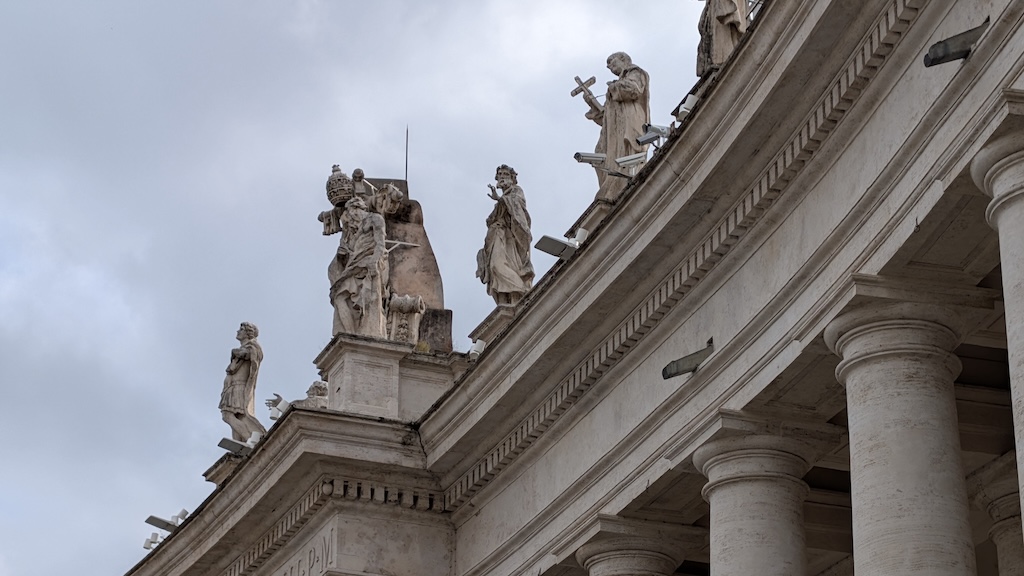
Once we arrived at the end of the line, it wasn't so bad. The line moved quickly, but gave us time to get our bearings before entering through airport-style security. The one annoyance that would dog us throughout the tour, however, was already making itself known... A Chinese tour operating on a close radio frequency to our own was cutting over our guide and making it difficult, if not impossible, to hear what she was telling us.
The first great church on the site was built in the fourth century under the Roman emperor Constantine, who was the first Roman emperor to openly support Christianity. This earlier building, now known as Old St. Peter’s Basilica, was begun between about 326 and 333 and was completed several decades later. It was a large, five-aisled church designed in the early Christian basilica style, with a long central nave, side aisles, and an atrium at the entrance. For centuries, it served as one of the most important churches in Rome.
Old St. Peter’s became a major destination for pilgrims from across Europe. It was associated with important ceremonies, including papal events and imperial celebrations; for example, Charlemagne was crowned emperor there in the year 800. Over time, however, the old basilica began to show its age. By the fifteenth century, parts of the building were in poor condition, and popes began considering whether it should be repaired or replaced. The idea of a grand new basilica slowly took shape.
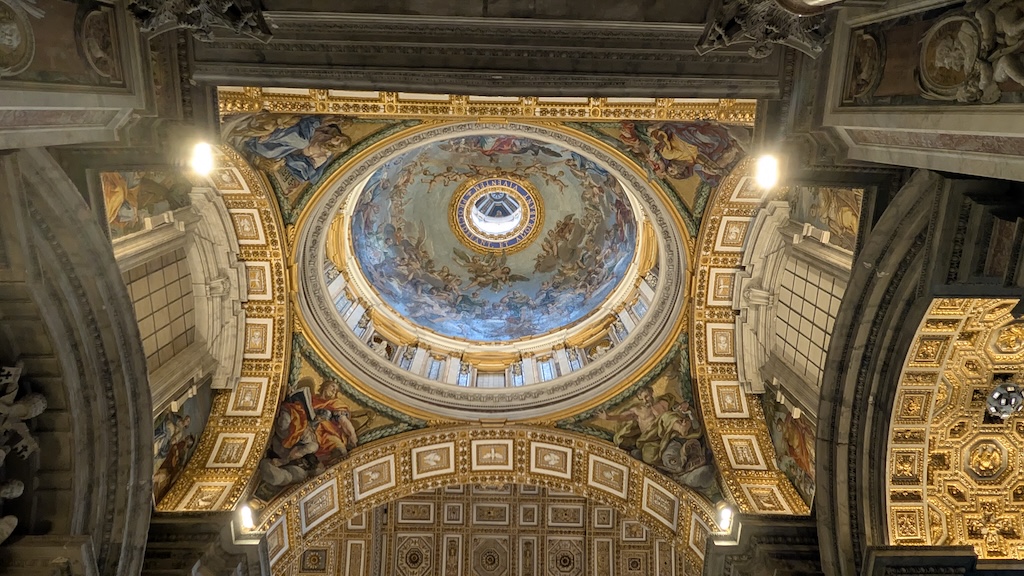
When I walked inside, which you will see in the 360-degree video below, the entire place immediately overwhelms you. The art, the decor, the sheer size, the insanely high ceilings... All of this dominates your senses and makes you feel so small. Perhaps that was the intention in the design.
As I took in the statues and artwork, I was told that there were no paintings in the Basilica. Everything I thought was a painting was, in fact, a tile mosaic... This blew me away. The images and the colors were stunning enough, but to realize that someone had meticulously assembled pieces so tiny as to be almost indescernable was too much.
The modern St. Peter’s Basilica began under Pope Julius II, who laid the first stone on April 18, 1506. Rebuilding the church was an enormous and controversial project because it required demolishing much of the ancient Constantinian basilica. The first major architect was Donato Bramante, who planned a bold Renaissance church with a central dome. After Bramante’s death, several other architects continued the work, including Raphael and Antonio da Sangallo the Younger, each adjusting the design as construction slowly moved forward.
One of the most important figures in the basilica’s history was Michelangelo, who took charge of the project in 1546 when he was already in his seventies. He simplified earlier plans and gave the building a stronger, more unified design. His most famous contribution was the great dome, which became one of the defining features of Rome’s skyline. Michelangelo did not live to see it finished, but Giacomo della Porta and Domenico Fontana completed the dome between 1588 and 1590, following and adapting his design.
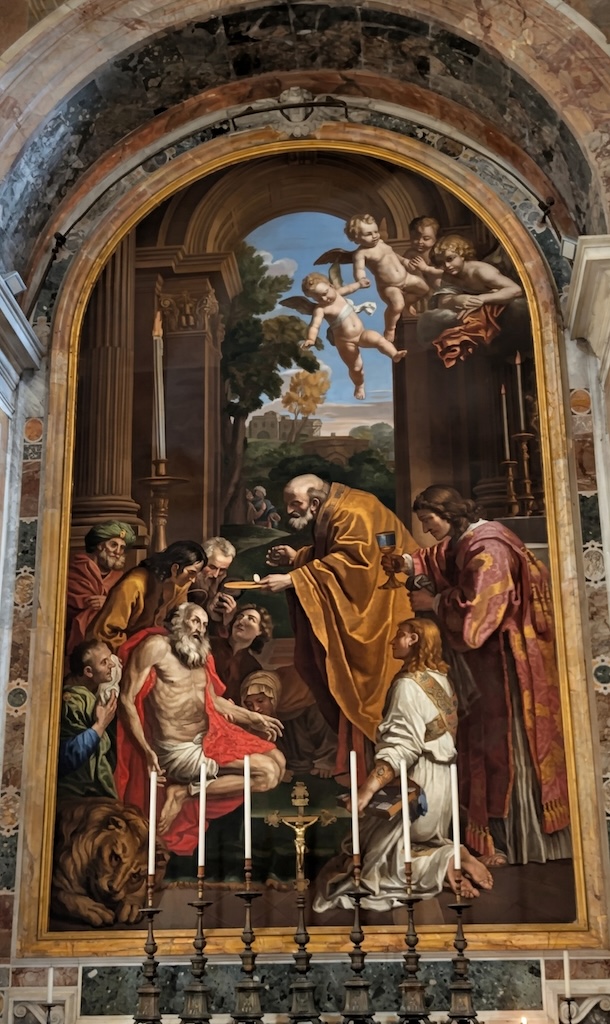
There was nowhere you could look in this incredible place that didn't crowd immeasurable artistry and skill into every inch of surface area. The thought crossed my mind that one could spend an entire lifetime documenting and studying the imagery, the iconography, the hidden messages and meaning that were like carefully arranged graffiti over every visible surface.
Understanding that such a display of wealth through times of hardship and famine for the common person must have been almost a slap in the face, it was nevertheless amazing to take in in person. No photo or video can ever do justice to what we saw there.
In the early seventeenth century, Carlo Maderno extended the nave and completed the broad front façade, giving the basilica more of the long church shape familiar to many visitors today. The new basilica was consecrated on November 18, 1626, more than a century after construction began. Later, Gian Lorenzo Bernini added some of its most famous Baroque features, including the great bronze baldachin over the main altar and the sweeping colonnades of St. Peter’s Square, which were completed in the 1660s.
We left, deciding to forego the hundreds of stairs into the dome. We were already tired enough and we still had the vatican museum to explore later in the day. We went outside and saw the Swiss Guard in their colorful uniforms and it was hard not to be impressed by the discipline they displayed. Now, however, it's lunch time.
360 Video: 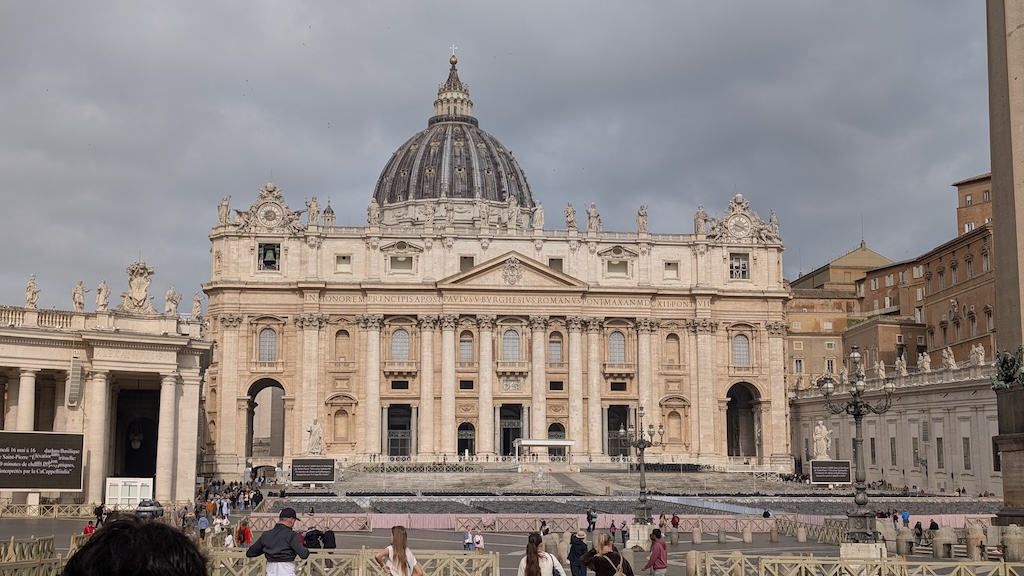




Comments