August 9
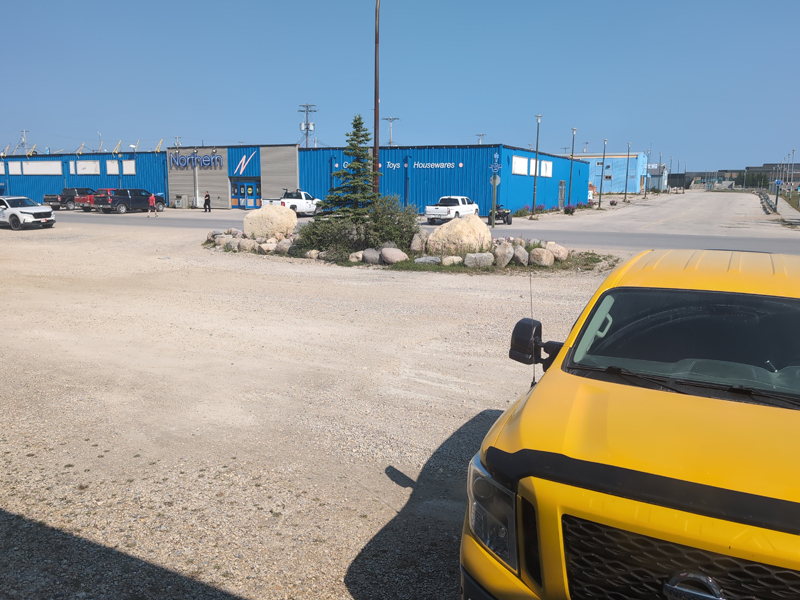
We woke up well-rested and ready to begin a new day. The first order of business would be for us to stock the fridge. That meant my first visit to a Northern Store. These are stores that are found all the way across the northern-most parts of Canada. They are the sole remnant of the Northwest Trading Company, the primary rivals of the Hudson Bay Company for control of this part of North America.
The inside looked like most any other modern store until you looked at the prices. Yup, it was going to be expensive. But we expected that and I gathered items from the list we had compiled earlier that morning.
Having arranged and organized the groceries, discussion turned to what we should do. One thing stood out in my mind immediately. As I have mentioned when talking about the journey here, I noticed something on Google Maps that looked like the remains of a small subdivision near the tracks. I wanted to get there and see if I could figure out what it had been, if anything interesting at all. Certainly, Google wasn’t giving me any clues.
When we arrived, I quickly spotted a monument that told me what it was, and it was the closing chapter of a heartbreaking, yet all too common story.
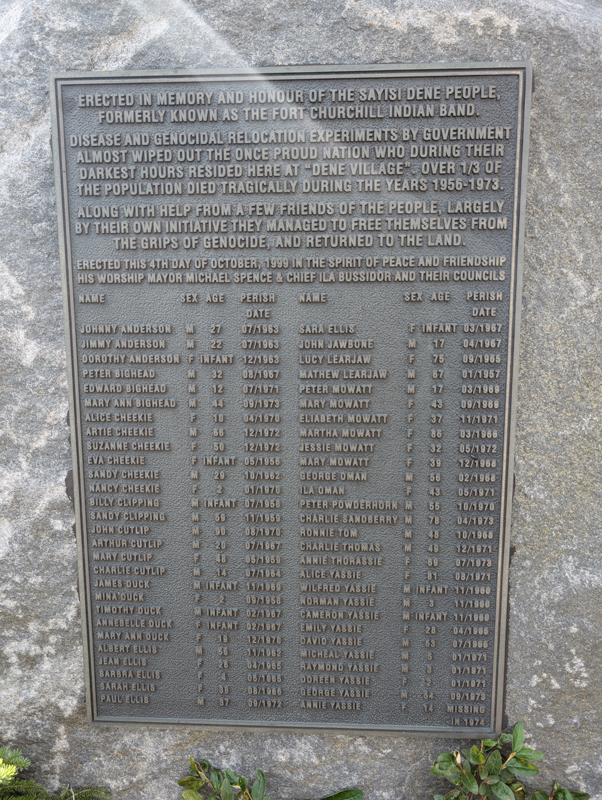
The Sayisi Dene people lived a mostly nomadic life, following the herds of caribou on which their survival depended. When the Hudson Bay Company established itself at Prince of Wales Fort near Churchill in the 18th century, a mutually beneficial arrangement was established, and things were generally good for both sides.
In the 1950’s, however, the fur trade began to crumble, and so too the trading relationship with the Sayisi Dene. They were not very concerned. There was some impact, but all the essentials they required were still in place.
A photographer from Winnipeg visited in 1956 to see how the people were getting along. He took a photo showing a large array of caribou carcasses and claimed that this was evidence of wasteful hunting. In fact, what he was looking at was the supply for the entire group for the whole winter.

Rumors of overhunting spread, and people demanded action.
On August 17, 1956, government aircraft began arriving at Little Duck Lake. The Sayisi Dene were gathered up, loaded on the planes, and flown to Churchill. Their belongings, their tools for hunting and surviving were all left behind. No real explanation was given to them about why they were being moved, and certainly no permission was sought.
They found themselves living in shacks between the water and the cemetery, violating a strong taboo in their culture. It was open land, with inadequate shelter. They were left nothing that would help to keep them alive. They were kept here for 10 years. During this time, they were losing their knowledge and survival skills, and they were becoming the targets of racism from the local population.
In 1966, the Canadian Government built a new housing settlement for them, 6.5 kilometers south of Churchill. That would place it exactly where I was standing when I found the monument. It was announced that twenty homes would be built, and the following years would see the addition of 40 two-, three- and four-bedroom houses.
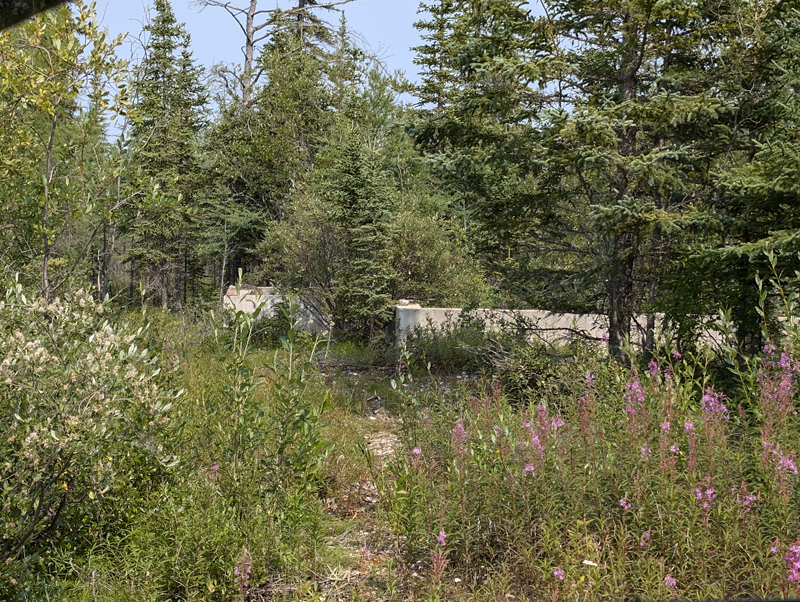
These houses were still inadequate for the climate. The people designing them in Ottawa had no idea about the conditions facing people in Churchill. In little time they were falling apart. With little wood around to burn, the people began tearing off parts of the house to burn. This apparent ungrateful behavior in the eyes of the non-indigenous citizens in Churchill just increased the racist rhetoric.
By 1969, enough was enough and people began leaving the village to return to the land. Their survival depended on them returning to what they knew and starting over. Eventually, in 1973, the group settled in Tadoule Lake, about 250 km west of Churchill.
Both the Manitoban and Canadian governments have apologized for the forced relocation, and financial compensation has been given, but the dead are still dead, and the scars remain. I was left with little to do except mark the location of the memorial on Google Maps in the hopes that future tourists would venture this far out of town to learn the fate of the Sayisi Dene people.
We moved on to happier endeavors as far as the School of the North.
| The Experience - Part 3 --> |